Castle County Sheriff's Office
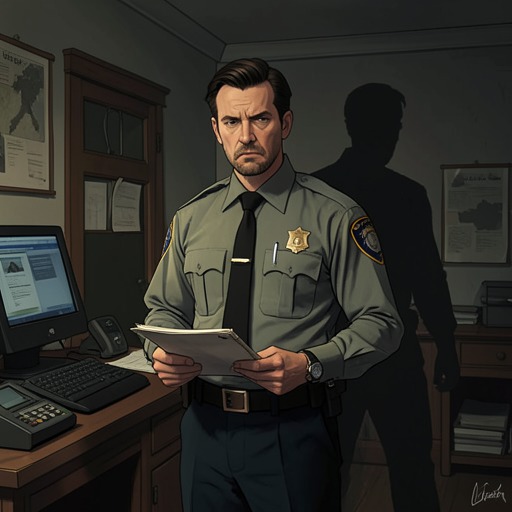
The Dark HalfThe Castle County Sheriff's Office is the local law-enforcement agency serving Castle Rock, and the institution through which the novel’s murder investigation first reaches Thad Beaumont. Under Sheriff Alan Pangborn, it moves from a missing-person report and physical evidence toward a suspect whose fingerprints challenge ordinary explanations; later, Stark’s control of Pangborn turns the office’s communications network into an instrument of concealment.
Jurisdiction and Leadership
Pangborn had been sheriff for nearly eight years when Homer Gamache was found dead beside Route 35. He had not been in Castle Rock during the town’s earlier notorious cases: before moving into local law enforcement in 1980, he had overseen highway enforcement in a small-to-medium-sized city in upstate New York, near Syracuse. Despite that experience, the new murder made him wish briefly that he were back there. His private correction—that Castle Rock had been a good place for his wife and sons, and for him—sets his work inside a community he values, even as its apparent run of bad luck resumes.
The office has a small field force. When Gamache was first reported missing, Pangborn had only three officers available: one was on patrol, while Andy Clutterbuck was in Auburn at district court. Norris Ridgewick, the deputy who reaches the initial scene, reports by radio and is told to stay put. Pangborn’s direction that Ridgewick keep Mrs. Arsenault company while waiting for him conveys the office’s practical, close-range work: officers must manage witnesses as well as evidence, with limited staff and changing circumstances.
The Gamache Investigation
The case begins with a call from Mrs. Gamache. Her husband, sixty-seven-year-old Homer, had left for his regular league bowling at seven the previous evening and had not returned by morning. She had woken at seven to find the beds empty and his truck gone. Sheila Brigham, the day dispatcher, relayed the call; Pangborn, then refueling at Sonny Jackett’s Sunoco station, returned it from a pay phone and took down the identifying details of Gamache’s white 1971 Chevrolet pickup, including its maroon primer patches and Maine registration. The office broadcast the vehicle information to the officers in the field. At first, Pangborn considered the possibility that Gamache had stayed with a bowling teammate after drinking, but the unexplained absence of a call to his wife left an unresolved question.
The search changes abruptly when Frank Gavineaux, walking home from fishing at Strimmer’s Brook, sees legs in the weeds south of Route 35. His mother calls the Sheriff’s Office, and Brigham relays the report to Pangborn and Ridgewick. She follows protocol by withholding names over the radio, where people listening on police-band scanners might hear them. The discovery confirms that the missing-person inquiry has become a homicide investigation. Ridgewick’s radio report and Pangborn’s instructions place the office at the scene, coordinating response while trying to protect information from public transmission.
The identification and circumstances of the death make the case particularly difficult. Gamache’s body is badly damaged, and Pangborn relies on distinctive identifying features, including the prosthetic left arm and gold teeth. Later, he tells Thad and Liz Beaumont that the medical evidence and a witness’s account place the killing between one and three in the morning on June 1. Gamache was killed with his own prosthetic arm. His pickup is subsequently found in a Connecticut rest stop near the New York border, where investigators recover several prints attributed to the perpetrator, including one made in gum on the dashboard and another in blood on the rearview mirror.
Thad Beaumont as a Suspect
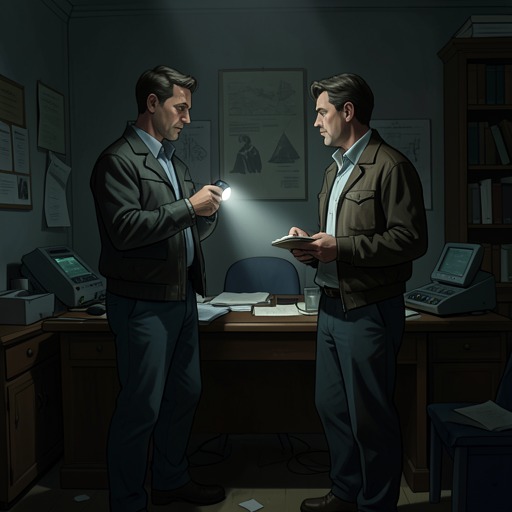
The forensic comparison directs suspicion toward Thad. When the prints are processed through the Armed Services Records and Identification graphics computer, the result is a match to his service record. Pangborn and two state troopers go to the Beaumont home on police business. Thad objects that he has no idea why they are there and insists that he will not accompany them without understanding the accusation. He invokes the couple’s long-standing summer-house connection to Castle Rock and challenges Pangborn’s presence far from the sheriff’s own territory, while maintaining that he has done nothing.
Pangborn’s initial suspicion does not prevent him from testing alternative explanations. Thad reconstructs the apparent case against himself as an elaborate twin deception: one version of him could have attended a party in Ludlow while another murdered Gamache, left the truck in Connecticut, continued to New York, and gone on to Washington, D.C., before returning. His account is deliberately absurd, but it exposes the practical problem in the evidence: the prints identify Thad even as his whereabouts appear incompatible with the crimes. Pangborn says Thad seems truthful and explains that he has experience judging whether people lie; he does not treat that impression as a substitute for procedure.
Thad then questions the quality and admissibility of the prints. Drawing on research he had done for the George Stark novels, he asks whether fingerprint evidence requires a minimum number of comparison points. Pangborn answers that Maine requires six perfect comparisons for a print to be admitted. The exchange shows the investigation moving beyond a simple match: Thad presses the sheriff to distinguish an apparent identification from evidence that can withstand scrutiny. The office’s case thus depends both on the collected material and on whether its meaning can be established under the relevant rules.
Communication, Procedure, and Compromise
The Sheriff’s Office remains the channel through which Thad tries to reach Pangborn as the investigation develops. Calling from Ludlow, he speaks first with Ridgewick, who does not initially recognize his name. Thad explains that he has information about the Gamache murder and needs the sheriff urgently. Ridgewick then remembers Pangborn’s instruction that if Beaumont called, he was to be put through immediately; his startled realization underscores that the sheriff had already anticipated a call and left specific directions for the office to follow.
Pangborn insists that Thad provide what he knows that night, even though they will also need to meet the following day. He says the New York authorities’ interest is secondary to his own responsibility to Castle County, where people want Gamache’s killer caught. Because Thad is already a suspect, Pangborn warns that he can ask the Penobscot County district attorney to have him held as a material witness in a Castle County murder case. This is not an arrest, but it makes clear that the sheriff can use legal procedure to compel cooperation. His directness combines urgency with a willingness to listen: he believes Thad has told the truth, yet still requires information that may advance the investigation.
The office’s routine phone system later becomes part of Stark’s manipulation. While Stark holds Pangborn near Castle Lake, Pangborn calls the Sheriff’s Office and Sheila Brigham answers on the first ring. Stark listens closely. Pangborn reports that radio transmission is ineffective in that area, asks whether Ridgewick has returned, and directs that Ridgewick take the desk when he arrives; until then, Clutterbuck is to cover it, even though his shift has ended. Pangborn explains that he is calling from the Beaumont place, where he was sent to check a State Police report, and says the inquiry has produced nothing. Each detail sounds like ordinary work coordination, but the call is made under Stark’s supervision. The office’s network still functions, yet the sheriff’s words are constrained by the threat beside him.
Narrative Significance
The Castle County Sheriff’s Office anchors the novel’s supernatural crisis in recognizably procedural work: dispatch calls, vehicle descriptions, witness reports, print comparisons, jurisdictional boundaries, staffing decisions, and legal pressure. The evidence initially points toward Thad with the authority of a computer comparison and crime-scene prints, but the sequence also gives him room to question how that conclusion was reached. Pangborn’s investigation is therefore not simply a contest between certainty and disbelief; it is a process in which physical evidence, personal judgment, and unexplained events repeatedly pull against one another.
The office’s ordinary routines also sharpen the contrast between institutional order and Stark’s intrusion. Brigham’s careful radio protocol limits what the public can overhear; Ridgewick’s remembered instruction ensures that a suspect’s call reaches the sheriff; Pangborn allocates an officer to cover a desk. Those procedures continue even when the explanation for the evidence exceeds the police department’s ordinary framework. By the time Stark controls Pangborn during a call to the office, the same channels that organized the investigation have become vulnerable to a hostile presence, without ceasing to look like routine law enforcement.